Laundry Room Design: The Small Room That Organizes Your Life

Design choices make the cue obvious and the action effortless. And nowhere does that matter more than the laundry room.
It’s one of the smallest rooms in the house — yet it quietly carries the weight of half your life. It’s a pass-through, a catch-all, a folding station, a drying room, a sports locker, and sometimes even a seasonal closet. And because it’s often tucked away at the back of the house, it becomes the place where things get temporarily “shoved” — and then forgotten.
Over time, that temporary solution becomes permanent clutter.
Today, we’re looking at laundry room design not from a Pinterest-perfect lens, but from a designer’s system-based, brain-aware perspective. Because this room exists to organize you. And if it’s not doing that, it’s quietly adding stress every single week.
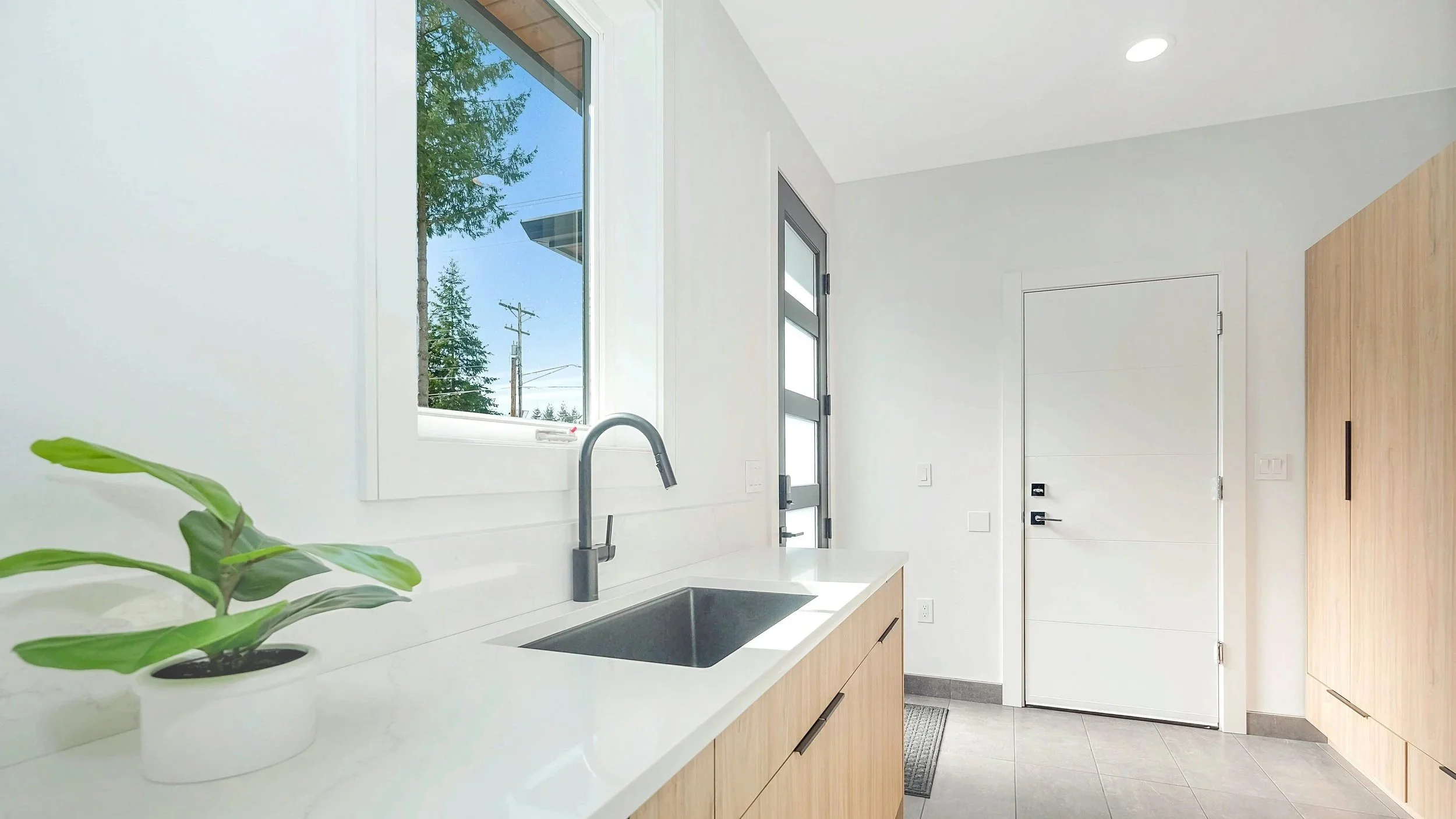
Before Storage, Zoom Out: This Is a Systems Problem
If your laundry room feels chaotic, it’s not because you’re bad at organizing. It’s usually because the room is trying to do too many jobs at once.
When tools live half in the garage and half in the laundry room…
When light bulbs are stored in three places…
When seasonal coats spill in because the entry closet is overflowing…
That’s not a basket problem. It’s a systems problem.
From a neuroaesthetic perspective, your brain is constantly scanning for order, predictability, and completion. When it encounters visual clutter or unfinished loops (like half-folded laundry or random storage piles), it experiences cognitive load — a subtle but constant friction.
So before adding shelves or buying new containers, ask:
What actually belongs here?
What doesn’t?
Where is crossover happening — and why?
I’m a firm believer in one home for everything. If something must live in the laundry room, it needs a proper, intentional home there. And if there isn’t room? It belongs somewhere else.
Often, fixing your garage system, your entry closet, or your storage strategy elsewhere will solve your laundry room chaos faster than adding another cabinet.

The Brain Hates Unfinished Cycles
Laundry is one of the most repetitive unfinished loops in the home. Washer running. Dryer buzzing. Clean clothes waiting. Baskets lingering.
If you feel like you’re always “in the middle” of laundry, that’s not just a time issue — it’s a system breakdown.
What changed everything for me was assigning laundry specific days.
Wednesday: multiple loads.
Saturday: bedding and towels.
And on other days? I didn’t think about it.
Blocking time to see laundry through from start to finish reduces background stress dramatically. It creates completion. And completion is calming to the brain.
Design supports systems — but systems come first.

How Designers Actually Approach Laundry Room Design
Once the system is clear, then we design.
And designers don’t start with baskets. We start with layout.
1. Layout Before Finishes
Most laundry rooms were placed where plumbing was convenient — not where life flows.
Start with the door.
Is the door swing eating up valuable wall space? In some cases, this is one of the rare moments where a pocket door makes sense — if it frees up an entire wall for cabinetry or counters.
Then look at cabinetry. Laundry rooms benefit from:
Long, uninterrupted counter runs
Continuous cabinetry
Uppers that run to the ceiling
When cabinetry stops short of the ceiling, you lose storage and create visual noise. Tall uppers draw the eye up and immediately make the room feel finished.
If budget is tight, this is where thoughtful design matters:
IKEA cabinet boxes with custom fronts
Painted lowers paired with wood-grain uppers (avoid trying to match wood tones — it almost never works)
Replacing door fronts rather than full cabinetry
Small shifts can elevate the entire space.
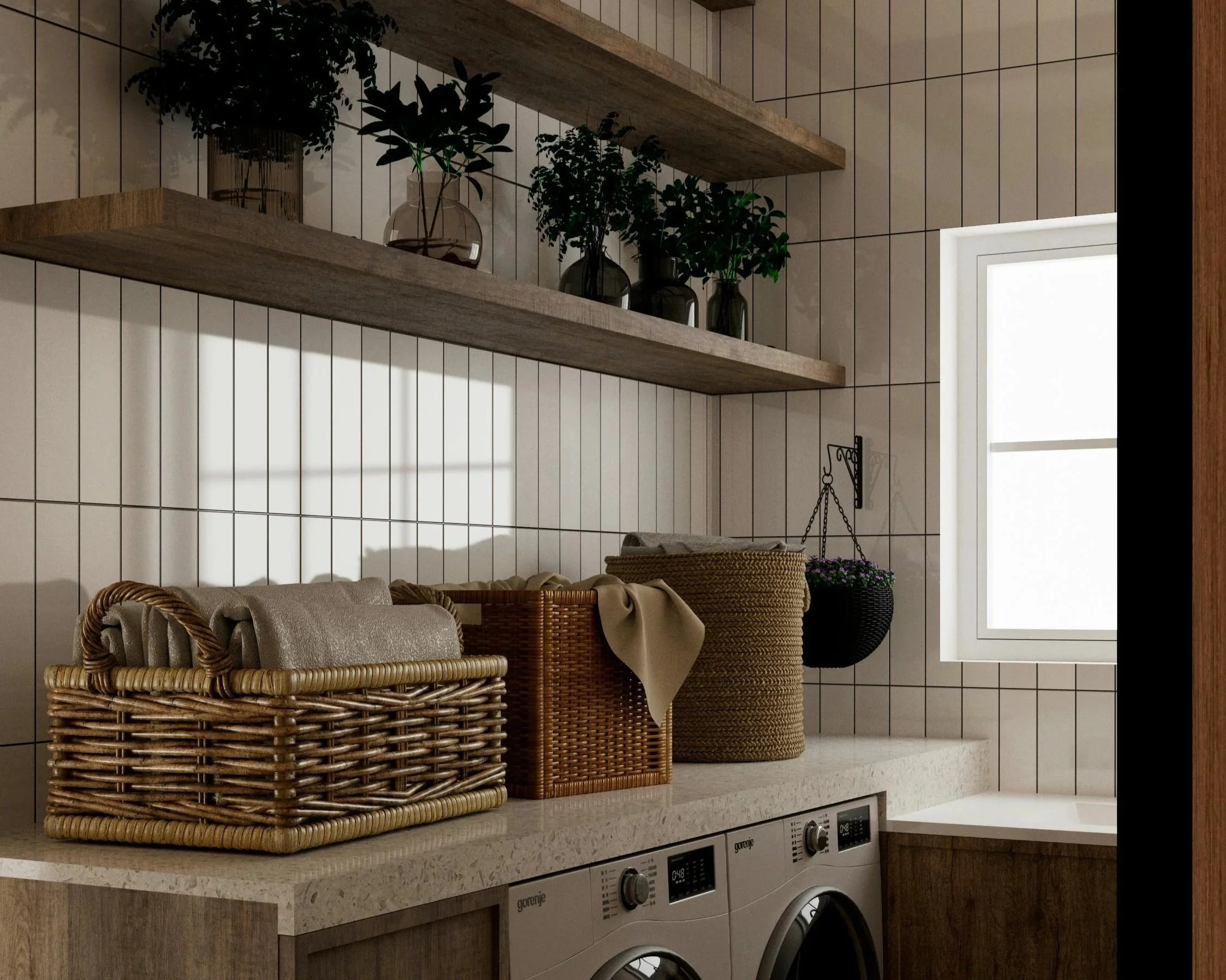
2. Appliance Configuration Matters More Than You Think
Stacking machines can completely transform what’s possible in a small room. The moment you stack, you gain:
Counter space
Storage
Breathing room
Front-loading machines allow for counter runs above. But if you elevate them on risers, you may lose that counter opportunity. Every decision should be based on how you actually use the space.
If the room is large enough, an island or central folding table can work — but only if circulation remains easy. Laundry rooms should feel efficient, not tight. Resolved, not crammed.

3. Small Rooms Are Design Opportunities
Because square footage is limited, this is one of the easiest rooms to elevate materially.
You can:
Choose a special tile
Add wallpaper
Install a beautiful utility sink
Upgrade lighting and hardware
An oversized light fixture or vintage-style sconces can move the room out of utilitarian territory and into designed.
Closed cabinetry calms visual noise immediately — especially in laundry closets you walk past frequently. If the door is open, what you see matters.
And if your cabinets stop short of the ceiling and things are piled on top? That’s your cue. Enclose it. Finish it. Resolve it.

DIY Refresh vs. Full Overhaul
An overhaul doesn’t mean luxury. It means thinking holistically:
Door placement
Cabinetry strategy
Lighting plan
Plumbing and electrical considerations
A DIY refresh works within the existing footprint — but here’s the key:
Don’t limit your thinking too early because of budget.
Instead, ask:
If budget weren’t a factor — but the structure stayed the same — what would this room actually need?
Would you:
Extend cabinetry?
Change the door type?
Add taller uppers?
Improve lighting?
Create a longer counter run?
That exercise reveals the real issues — even if you scale back later.
Thoughtful DIY design is strategic. Piecemeal upgrades feel temporary.

The Laundry Room Is Not a Leftover Space
If there’s one thing to take away, it’s this:
The laundry room is not a leftover space.
It’s a system. And systems shape behavior.
When this room lacks clarity, it creates:
Visual noise
Friction
Unfinished cycles
The constant sense of being behind
But when layout is considered, cabinetry is intentional, and materials are chosen for real use, the room starts working with you.
From a neuroaesthetic standpoint, good laundry room design reduces mental load. It makes the cue obvious, the action easy, and the endpoint clear.
And that’s why this small room has such an outsized impact on how your home feels week to week.
Start Here
Instead of asking, “How do I organize this better?”
Ask:
How should this room actually work?
Then walk into your laundry room this week and simply notice where friction shows up.
That’s always the starting point.
For more design guidance and resources, visit yourparo.com and follow along on Instagram @yourparo or @bynico.space, where I share design thinking, systems, and the psychology behind how our homes shape us.
Create space for better living.